Welcome to Brasslink International Company!

- Call Us for help!
- +91 9819742205
- Mail Us
- Brasslinkinternational@gmail.com

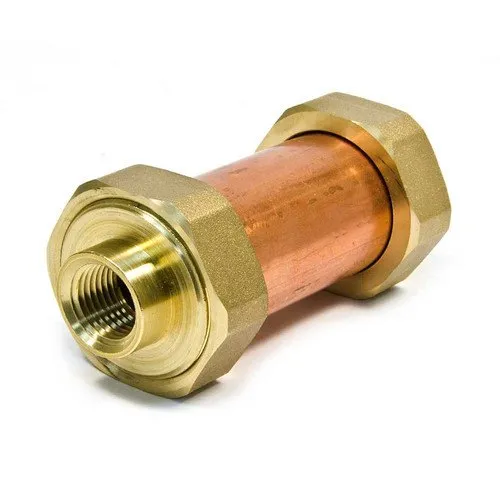
Copper Check Valve
Manufacturer,Stockist and Exporter of Copper Check Valve
Copper check valves are essential non-return devices designed to allow flow in one direction while preventing reverse movement of fluids. The body is primarily constructed from copper alloys, delivering high resistance to corrosion and mineral scaling. These valves are widely used in residential plumbing, HVAC lines, irrigation systems, and industrial liquid transfer. Their low maintenance requirements and long service life make them a dependable option in continuous-flow networks. Copper’s natural antimicrobial properties reduce bacterial accumulation, which is particularly valuable in potable water systems. Manufacturers typically offer threaded, soldered, or flanged connection types for different piping layouts. By ensuring backflow prevention, copper check valves protect pumps, compressors, and downstream equipment.
In plumbing systems, a copper check valve acts as a passive component, engaging automatically without manual control. It closes through internal components such as a disc, spring, or swing arm, triggered by pressure differentials. When forward flow is present, the valve opens, allowing smooth fluid passage with minimal resistance. When reverse pressure occurs, the closure element returns to its seat, sealing the passage rapidly and securely. This operational mechanism prevents contamination and back-siphonage from incoming and outgoing distribution lines. Copper materials are favored because they tolerate high temperatures and aggressive water conditions. As a result, installers choose copper check valves for both new plumbing installations and retrofit projects.
Copper check valves are available in multiple configurations, including swing, lift, axial, and ball designs. Swing types use a disc hinged on a pivot, ideal for low-velocity flows with minimal turbulence. Lift check valves rely on vertical motion: a guided disc rises during forward flow and drops when pressure reverses. Axial or in-line versions provide highly responsive closure with spring-assisted elements, commonly used in compact systems. Ball check valves use a spherical component seated in a tapered chamber, delivering robust sealing performance. Each design offers a balance between pressure drop, installation footprint, and energy efficiency. Choosing the correct configuration ensures proper hydraulic performance and longer equipment life.
The copper alloy composition used in these valves may include tin, zinc, or nickel to improve mechanical strength. Alloying enhances tensile properties and fatigue resistance, crucial in systems with pulsating or cyclical flows. Some formulations also increase dezincification resistance, ensuring metal integrity even in high-chloride environments. Because copper naturally resists oxidation, it maintains aesthetic and structural stability in demanding applications. Manufacturers design these valves to handle potable water, oil mediums, select chemicals, and low-pressure steam. Their stability makes them suitable for both indoor mechanical rooms and outdoor utility installations. Regardless of the application, the alloy selection directly influences performance and reliability.
HVAC systems use copper check valves to prevent refrigerant return or liquid migration to compressor housings. Reverse refrigerant flow can damage internal components, leading to efficiency loss or catastrophic equipment failure. A properly sized check valve ensures compressors remain lubricated and protected during start/stop cycles. In chilled water networks, the valve prevents unintended flow loops that can disrupt zone balancing. Copper’s ability to endure temperature fluctuations and thermal cycling makes it ideal for HVAC infrastructure. Furthermore, copper fittings integrate easily with brazed or soldered line sets, simplifying installation procedures. Technicians often prefer copper valves due to proven compatibility with refrigerant oils and system metals.
Marine applications rely heavily on copper check valves because of their superior resistance to seawater corrosion. Brass or bronze alloys derived from copper deliver stable performance even in saline and humid environments. Engine cooling loops, bilge discharge systems, and onboard freshwater lines benefit from check valve protection. Without proper backflow prevention, contaminated water can reenter tanks or critical machinery components. The long-term reliability of copper alloys helps reduce service intervals and maintenance budgets. Boat builders value the low profile of compact copper in-line valves for tight compartments. These valves maintain stable flow under varying vessel motion and pressure conditions.
Industrial users deploy copper check valves for moderate-pressure liquid transfer, plant utilities, and chemical distribution. While not meant for extreme pressure ratings like forged steel valves, they excel in medium-duty service. Their compatibility with copper, PEX, and stainless piping makes them flexible in hybrid system designs. Process engineers appreciate their predictable sealing performance, especially in repetitive duty cycles. The valves can be integrated with pump discharge lines, tank outlets, and heat exchangers. Copper’s machinability allows precise tolerances, reducing leakage risks around seat faces and stem guides. This precision supports stable, energy-efficient operation throughout the valve’s lifespan.
Installation guidelines emphasize correct flow orientation, usually marked with an arrow embossed on the valve body. Improper installation can lead to chatter, premature wear, or complete failure of the valve mechanism. Horizontal or vertical mounting may be permitted depending on the valve design, especially for lift types. Adequate upstream and downstream straight piping length ensures laminar flow and reduces turbulence. Soldered joints must be properly cleaned and fluxed to prevent scaling and joint weakness. Threaded connections should be sealed using PTFE tape or approved sealant compatible with copper. Following best practices ensures peak performance and prevents unnecessary call-backs.
Specification Of Copper Check Valve
| Specification | Description |
|---|---|
| Product Name | Copper Check Valve (Non-Return Valve) |
| Material | Copper Alloy / Bronze / Brass (Depending on Model) |
| Valve Type | Swing / Lift / Spring Loaded / Ball Type |
| Connection Ends | Threaded (NPT/BSP), Soldered, Compression, or Flanged |
| Size Range | 1/2” to 4” (Custom sizes available) |
| Pressure Rating | PN10–PN16 / 150 PSI–300 PSI (Application Dependent) |
| Operating Temperature | -20°C to 180°C / -4°F to 356°F |
| Applicable Fluids | Potable Water, Oil, Air, Non-corrosive Liquids, Low-pressure Steam |
| Flow Direction | Unidirectional (Marked with Arrow on Valve Body) |
| Body Finish | Natural Copper / Polished / Nickel Plated |
| Seat Design | Metal-to-Metal or Elastomeric Seat |
| Seal Material | PTFE / EPDM / NBR (Depending on Medium) |
| Installation Orientation | Horizontal / Vertical (Depending on Valve Type) |
| Standards Compliance | ASTM / ISO / EN / DIN as per model |
| Applications | Plumbing, HVAC, Marine, Irrigation, Industrial Utility Lines |
Maintenance routines for copper check valves are generally minimal, thanks to corrosion-resistant materials. Periodic inspections verify closure integrity and confirm there is no debris obstructing the seat. Swing valves may experience hinge pin wear if subjected to vibration or cavitation. Axial valves with springs may require occasional spring replacement depending on service intensity. Internal deposts can be flushed using mild descaling agents compatible with copper alloy surfaces. Preventive maintenance schedules depend on fluid type, pressure cycles, and installation environment. Consistent upkeep directly enhances valve lifespan and system reliability.
Copper check valves are engineered to produce low head loss, preserving pump efficiency in pressurized networks. The geometry of the flow channel and seating faces minimizes turbulence and velocity disruption. Swing models offer the lowest pressure drop but respond slightly slower in rapid reversal conditions. Spring-loaded axial valves close faster, preventing surge or water hammer in sudden shutoff cases. Manufacturers publish flow coefficients (Cv) to assist engineers in sizing for target flow rates. Undersized valves lead to choking and excessive pressure drop, while oversized valves may cause unstable closure. Proper selection balances energy efficiency with safe operation.
Temperature performance is one of copper’s primary strengths. Copper check valves handle hot water, low-pressure steam, and heated oil without structural degradation. Unlike some plastics, copper does not soften or deform when exposed to sustained heat cycles. This property is crucial in solar heating loops, geyser systems, and boiler feed lines. Copper alloy seats retain surface hardness, maintaining effective sealing even after thermal expansion. Such durability ensures fewer repairs and reduces risk of thermally induced leakage. Installers trust these valves in demanding climate control and heating environments.
Chemical Properties Of Copper Check Valve
| Chemical Element | Symbol | Typical Composition (%) | Notes |
|---|---|---|---|
| Copper | Cu | 58 – 90 | Primary base metal; provides corrosion resistance and durability. |
| Zinc | Zn | 5 – 40 | Common in brass; increases strength and machinability. |
| Tin | Sn | 0.5 – 10 | Improves dezincification resistance and enhances hardness. |
| Lead | Pb | 0.1 – 3.0 | Improves machinability and sealing; reduced in low-lead/DRINKING WATER grades. |
| Nickel | Ni | 0.1 – 2.0 | Stabilizes structure and enhances corrosion resistance in aggressive media. |
| Iron | Fe | 0.05 – 1.0 | Improves strength and wear resistance. |
| Manganese | Mn | 0.05 – 1.0 | Strengthens alloy and supports uniform grain structure. |
| Aluminum | Al | 0.05 – 1.0 | Enhances dezincification resistance and mechanical stability. |
Copper check valves integrate well with modern eco-friendly infrastructure. Because copper is recyclable, end-of-life components can be reclaimed and repurposed without toxic byproducts. This reduces long-term environmental impact when compared to PVC or multi-polymer hardware. Many building codes support copper for potable water distribution due to hygienic benefits. The antimicrobial nature of copper helps suppress biofilm formation, improving water quality. When used with low-lead copper alloys, these valves meet global drinking water safety standards. This sustainability advantage aligns with green building certifications and responsible engineering practices.
From a cost perspective, copper check valves offer strong value when compared to stainless steel alternatives. They deliver excellent corrosion resistance and mechanical stability at a moderate price point. Stainless steel models may outperform in extreme pressure or chemical environments, but at higher cost. Copper valves are generally more compact, lighter, and easier to handle during installation. Reduced labor time contributes to lower total project expenses, especially for residential or commercial builds. Availability is widespread, and fittings are compatible with standard copper piping inventories. This makes copper check valves ideal for high-volume construction and utility service deployments.
In irrigation networks, check valves eliminate the risk of contaminated water flowing back into municipal supplies. Copper’s resilience to mineral content means less scaling in hard water areas with high calcium or magnesium. Sprinkler heads, drip lines, and pump intakes all benefit from one-direction flow control. Using copper valves reduces maintenance frequency and clogging issues common with plastic or rubber devices. Farmers and landscapers gain predictable irrigation patterns and pump protection. With the right sizing, pressure levels remain balanced across multiple distribution channels. These features improve system efficiency and crop or landscape hydration outcomes.
Mechanical properties Properties Of Copper Check Valve
| Property | Typical Range / Value | Units | Notes |
|---|---|---|---|
| Tensile Strength | 200 – 520 | MPa | Depends on alloy (brass/bronze) and heat treatment. |
| Yield Strength | 90 – 350 | MPa | Determines pressure tolerance and resistance to deformation. |
| Elongation at Break | 10 – 35 | % | Indicates ductility and ability to absorb stress. |
| Hardness | 50 – 180 | HB (Brinell) | Higher hardness improves wear and seat durability. |
| Density | 8.3 – 8.9 | g/cm³ | Varies slightly with alloy composition. |
| Thermal Conductivity | 100 – 380 | W/m·K | Excellent heat transfer; suitable for hot water & HVAC systems. |
| Coefficient of Thermal Expansion | 16 – 19 | µm/m·°C | Important for soldered joints and temperature cycling. |
| Modulus of Elasticity | 90 – 125 | GPa | Relates to rigidity and resistance to flex under pressure. |
| Corrosion Resistance | High | - | Excellent against potable water, seawater, and mild chemicals. |